I just came out of the JLPT N3 test. I won't find out for another couple of months whether or not I passed, but I've got an inkling that I did.
Regardless, the process of studying for this test was an interesting, at times frustrating, but definitely exciting one.
I wouldn't say that the JLPT is a very well-rounded assessment of one's Japanese language skills; you might hear teachers advise you against studying 'for the test' as you'll miss some important aspects of the language that aren't directly tested (the most obvious example being speaking skills).
Whether you think the test is helpful or not for you in learning Japanese is up to you, but in case you do plan to take it, here are some ways I made studying easier for myself to the point where I'm somewhat comfortable in predicting that I will pass.
Fun fact: this isn't my first time taking the N3.
A little less than 2 years ago when I was on my way to Japan for the first time in my adult life, I badly wanted to learn the language, but knowing myself, I needed a proper source of motivation to do it. It was a 2-month trip, and I knew I would regret it if I didn't get any Japanese language skills out of it.
But I also knew, based on previous trips abroad where I've intended to learn the local language and then chickened out due to a lack of necessity or the fear of sounding stupid (see: Language Learning Plateau — Who?), that it was a real possibility that that would happen yet again.
Hence the decision to sign up for the JLPT. If I had an exam looming over me, I would be forced to study. Staying true to the geek in me and taking such a test seriously is something I could rely on. This track record of being 'generally smart', however, may have also made me a tad overconfident.
So, when my brother, who had previously lived in the country for 5 years and was a fluent Japanese speaker, suggested I sign up to take the N3 (on a scale of N5 to N1, where N5 is the easiest and I had no Japanese skills whatsoever beforehand), I didn't think to question it as much as any sane person should. If my brother thought I could do it, then I probably could, right? Turns out, I'm not quite the genius he thinks I am.
I studied hard, yet still, on the day of the test when I accidentally stopped a block short of where the N3 exam was going to be held and joined the N4 exam queue, and when a woman came announcing that the N3 exam was taking place elsewhere, it took me several minutes to figure out that something was up and I should make sure, eventually somehow picking up that I was in the wrong queue.
The invigilation was fully in Japanese; we were in Tokyo, after all. Did I really think English would be a common language between examinees? Whenever there was any instruction to be followed, I mimicked what everyone else in the room was doing. Safe to say that if I didn't understand simple commands like 'put your phones in this plastic bag' or 'keep your ID card on the table', I had no clue what the test paper was on about.
If reading a more detailed version of my utter failure of that test and the events of that day is something you think you'll enjoy, it is available here.
It was a shame, really. I did study. If I had taken the N4, there may have been at least the slightest possibility I'd pass.
This was on less than 2 months of preparation. Taking the N3 was a dumb, dumb choice back then.
But now? It's been a year and a half since, and while there have been periods where I haven't stayed in touch with the language, all in all, I've had much more exposure to it than on that day in Tokyo. And I can gladly say that this time, I understood a whole lot of what the test paper said. A surprising lot, in fact.
I didn't expect to be able to fully pick up the context of the reading comprehension passages. I thought I would have to at least somewhat rely on skimming and educated guesswork, but I understood a lot more than I thought I would. For fear of jinxing it, I think the exam went well.
So here it is, my self-study workflow towards becoming JLPT N3-proficient. I think.
I'll start from the basics.
I think it's quite important to have a properly charted out course to follow in the beginning. You don't know what you need to learn at this point, and getting lost amongst a pile of resources can become overwhelming.
My brother recommended the Genki books (Genki 1 and Genki 2) for me to begin with, and I think it was a good choice. These were the textbooks that the University of Tokyo used to teach Japanese to foreign students like my brother, so rest assured it's a popular choice.
The one thing I found lacking in those textbooks was the way that kanji was taught.
For those who are unfamiliar, Japanese uses three writing scripts — Hiragana (primary phonetic alphabet), Katakana (phonetic alphabet used for emphasis or loanwords), and Kanji (pictorial meaning-based Chinese characters that can be pronounced in different ways depending on the context they occur in).
While there are only a handful of Hiragana and Katakana characters, there are thousands of Kanji characters, and these quickly become confusing.
Kanjis are made up of smaller pictorial components called 'radicals', so many kanjis that use similar radicals can end up looking quite similar, and when you're learning these in the order of hundreds, you need a proper system to be able to distinguish between them.
I personally found WaniKani.com very useful for this. Each level first explains a handful of radicals, then a set of Kanjis that use those radicals with mnemonics that make them easy to remember (this is such a big help!), and finally vocabulary that uses the Kanji taught in that level.
While their flashcards and spaced repetition testing features are paid, the content of all levels (1–60) is freely available.
If you want to study material purely aimed at the JLPT, then I should tell you that WaniKani does not sort the Kanji at each level by JLPT-relevance.
As you can see here, if you're taking the N3, by studying up to level 30 out of 60, you will know around 90% of the Kanji required by the JLPT N3.
But this includes a sum total of over 1000 Kanji.
Cumulatively, you need around 650 for JLPT N3, but some of these will still be from outside the WaniKani coverage up to level 30. Over the past few months, excluding say the last month where I started orienting my study regimen more towards the exam specifically, I used WaniKani Level 30 as the milestone I wanted to get to in order to feel comfortable for the N3.
I did this, but I lacked the follow-up spaced repetition that I should have kept up with to properly cement everything I learned into my brain.
Still, the fact that I've thoroughly covered those levels once should make them easier to revise when I go back to them next, and actually review them periodically in order to retain them.
Later, when the N3 drew nearer and my study sessions became catered to the exam, I vibe-coded this webpage that made it easy for me to revise only the Kanji I was going to be tested on, with:
- easy links and keyboard shortcuts to open the associated WaniKani pages so that I could refer back to the mnemonics I originally used to learn each Kanji for ease of review
- a list of words containing each Kanji, also only from a dataset of words needed for the JLPT
- links from these words to jisho.org (I realized a lot of these words weren't actually available on WaniKani) where you can find information about other Kanji used in the word that may not be JLPT N5–N3 level, and see the word's usage in sample sentences (which is very important to know!!)
Each Kanji character present in each word in these lists is also colour-coded so that you know whether it is present in the list of N5–N3 Kanji that you'll need to know for the exam.
The Kanji you need to know is cumulative, meaning that for the N3 you also need to know all N5 and N4 level Kanji.
Note that the source I used for this Kanji list is this GitHub repository, which mentions that its source is mostly the same as the KANJIDIC dataset.
There hasn't been an official JLPT-level Kanji or word list released in over a decade, so online resources available currently are best-guess estimates.
Out of these, as for the word lists per JLPT Level, I've found the lists available at japanesetest4you.com to most accurately reflect the material I've seen in mock JLPT exams.
There'll always be some words that you miss even following such online lists, but you should know well enough to be comfortable in the exam.
Another highly recommended resource is the Shirabe Jisho app. Primarily a dictionary app, they offer word and Kanji lists by JLPT level too, and paired with this, they have a built-in flashcards feature where you can test yourself on these datasets with spaced repetition. I used Shirabe Jisho only for word lists, since I already had my own WaniKani-linked way to study Kanji. I found that there was significant overlap between the N3 word list in the app and the list at japanesetest4you.com/jlpt-n3-vocabulary-list/.
Not perfect overlap, and I'd still say the latter was slightly more reflective of mock tests, but Shirabe was definitely worth studying for the flashcards.
Once I was confident in that list, I used the JapaneseTest4You one as a revision guide, creating a custom flashcard deck on Shirabe Jisho (yes, you can do that too! Too much effort to input all ~2000 N3 words manually, but a good option to only cover the ones that the Shirabe list missed!).
And although in the days leading up to the test you may feel you don't want to use any brainpower on learning things you're not required to know, in the long run, learning a little extra vocabulary is only going to help, right?
Shirabe Jisho has very recently added JLPT-level tags to their word pages as well.
The lists have been available longer, but if you simply searched a word then there didn't use to be a way to know which JLPT level it corresponded to.
There also isn't a search feature within lists, so looking it up alphabetically, manually, was the only option.
Now, things are different. If you're studying a word from a JLPT list in the app, and you find another unfamiliar word in the sample sentences for the word you're studying, you can easily check whether that word is also at a JLPT level that you ought to know.
(I also want to add that this ease of navigating between words, seeing their composite Kanjis, seeing the radicals part of each Kanji, basically the entire navigation system of the app — it's *chef's kiss*. And now the JLPT-level annotations on word explanation pages is just the cherry on top.) It was a long-requested feature, and it's finally available.
If you're starting to study for the JLPT using Shirabe Jisho now — good timing.
Note that this is an iPhone-only app. If you're on Android, Jisho.org is an alternative, but it lacks the flashcards feature.
I know Anki is popular, although I've never thoroughly used it myself.
Some JLPT word/kanji decks are available online which people find very useful.
Again, I haven't used them myself, but if you can't use Shirabe Jisho, I recommend checking them out.
This next one is not JLPT-specific at all, but it's a golden bullet.
It's been the most effective way my brain has found to not only memorise but also retain words.
To put it simply — songs. I can't tell you how useful these are, more than any kind of immersion!
The reason is, lyrics are something you memorise. And lyrics are sentences, and sentences put words in context.
If you don't remember the meaning of a word on its own, knowing it in the context of a sentence, in the context of a verse of a song that you know the meaning of, speeds up recall so much that it becomes almost instant.
I've been using this method from very early on. I've always been good at memorising lyrics, and I had a desire to know what the (few, at the time) Japanese songs I listened to (basically songs from anime I'd watched) were talking about.
I understood the translations, and through them learned completely random sets of words.
I think my early knowledge of words that were way above the lower JLPT-levels may have caused some of my brother's false confidence in recommending me to take the N3 back then.
All it took was a thorough pass of the song with vocabulary and grammar breakdowns and explanations.
Any LLM could generate that for you in a minute.
Then, every time you listen to the song, it passively gets baked into your brain more and more until you're able to hear the word out of context, instantly map it to the lyric line you know it to be in, and recall what it means.
I thought initially that this was an amazing way to memorise vocabulary — that hasn't changed, but while I was learning new grammar patterns for the N3, I realized that some of them weren't entirely unfamiliar, just because I'd learned them in context of lyrics, not knowing that they were specific grammar structures covered in advanced textbooks.
(Take this part with a pinch of salt since lyrics aren't always 100% grammatically correct — artistic license, you know — but for the most part, consider learning grammar an additional bonus of using songs to study).
For the longest time, I had a spreadsheet with all the Japanese songs I was listening to and their lyrics, and a Google Scripts automation that would generate the lyrics translation and explanation and send it to my email with one new song every day.
It was sufficient, and I benefited a lot from it.
Some of my friends learning Japanese asked to be added as recipients, so that happened too.
I later found myself feeling that the idea had a lot more potential though — if a list of all the unique vocabulary words I had learned across songs could be generated, if I could be tested using flashcards of words from those lists, if I could seek to the point of the song track of the lyric line that I was reading without manually having to switch tabs between my email and Spotify, this workflow could all be a lot easier.
Well, being a software engineer after all, it wasn't all that difficult to build the thing out.
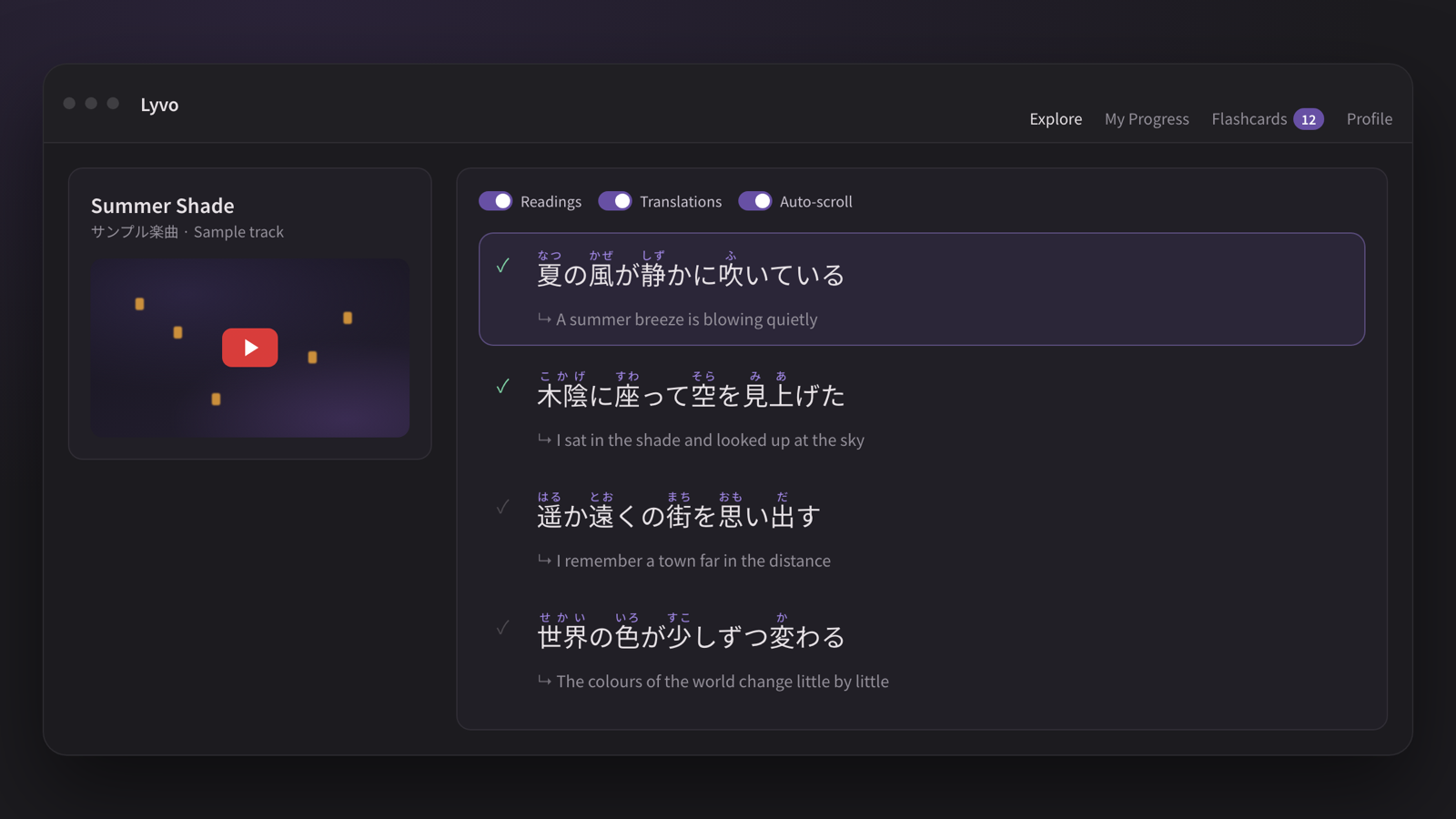
Check out Lyvo, the app that came out of this idea of learning languages through song lyrics. Join the waitlist — it's in active development and launching soon.
Speaking of songs also brings us to another important component of the language (and the exam) — listening.
Reading textbooks and learning Kanji will get you making progress on the written sections of the JLPT, but Listening is a section on its own, and you can't pass the JLPT without at least a minimum score on each individual section, including Listening.
If you're following the Genki books, there's a very useful Listening counterpart, which doesn't exactly correspond to the kind of Listening questions you'll see on the JLPT, but helps build your exposure to hearing Japanese being spoken early on. OTO Navi is an app where you can listen to audio recordings of all of the practice exercises in the Genki textbooks, along with their answers.
As far as I remember, they include pauses for you to think of the answer before revealing it, so it's a good way to work through the Genki textbooks altogether, in my opinion.
The app includes audio sources for many other books published by The Japan Times as well, but I've only used it for Genki so far.
I encourage you to check out the others as well though, as I'm sure there will be some hidden gems amongst them.
Another method I tried to improve my listening skills was using Lingopie, a platform where you can watch movies and shows in foreign languages with subtitles in both that language and English, with AI support to understand any word in further depth.
As a concept, I found this incredibly useful. The execution by Lingopie, particularly for Japanese… not as good.
I found several mistakes in the translations/word tokenisation, plus the media catalogue available for Japanese was not aligned with my interests much at all.
I didn't end up using it much, but if there are other similar platforms out there that do it better, it would be my second golden bullet (or is that a silver bullet?) after songs as a resource to speed-run learning a language.
Once you're somewhat comfortable with listening, I'd recommend moving on to doing JLPT Listening mock exams.
There are a lot of sources for these; I found the official audio from past JLPT exams the most useful, and there are plenty of these available.
I used the Listening tests in this playlist, for example.
Summary by JLPT level
I realize this was a lot of information, and it wasn't presented in a very structured way. Let me fix that.
To summarise, level-specific advice that I think should make you comfortable for the JLPT:
- N5: I haven't attempted this level; I went from N3→N4→N3. But from what I've heard, it should be enough to properly understand everything in the Genki 1 textbook (use OTO Navi!) + use WaniKani to study the Kanji tested at the N5 level (see N5 Kanji list).
- N4: Make sure you've gone through both Genki 1 and Genki 2, especially in terms of grammar. Similar to N5, you can cover Kanji using WaniKani, word lists from Shirabe Jisho and japanesetest4you.com, and make sure to do some mock tests before showing up to the exam, especially for the listening section.
- N3: The Genki books don't suffice in terms of N3 grammar. At this stage, an N3-dedicated textbook like Try! N3 becomes useful (in addition to basics from Genki 1 & 2). In my case, I didn't have enough time before the exam to study another textbook cover to cover, so I learned grammar points from this YouTube playlist which covers Try! N3 grammar instead. Similar to word lists, I found while doing mock N3 tests that this list in itself was not enough, so I ended up going through the japanesetest4you.com N3 grammar list in addition to the playlist from earlier. These combined gave me confidence on the grammar section in mock tests. I won't say they provide 100% coverage, but if I had to estimate, I knew probably around 80% of the actual pool of N3 grammar topics. Again, there's no 'official' list; this is just my own estimate based on how much I knew during mock exams and the real test.
Speaking of mock exams, I definitely recommend doing a few before showing up for the exam.
In particular, it's very helpful to be familiar with the question format before showing up to the actual test.
During my first, extremely underprepared N3 attempt, I ended up not realising that one of the questions in the listening booklet did not have any text or images in the question booklet and was purely audio-based.
I followed along with the images of the next question, ending up very confused about how it wasn't related to what little I could understand from the audio going on.
Then, when it was time for the question after that, which actually corresponded to the images, I was even more confused and probably ended up getting every part of both those questions wrong.
I trust you guys won't be in such bad shape as I was then, but in already unfamiliar territory, taking an exam in a foreign language, it's best to at least know the rules in advance.
Time is definitely a challenging factor in the JLPT (more so in the N2 than N3, I've heard, but I always had to be fully focused during the Reading section of the N3 to finish on time in mocks), so do whatever you can to give yourself an edge.
The bigger picture
I've said a lot about how to prepare for the JLPT.
Let me now disclaim that I don't actually advise studying entirely for the JLPT.
I did all of WaniKani levels 1–30 (not cherry-picking JLPT-specific Kanji) until a month or so before the N3 when I eventually became more exam-geared.
And even after studying like I did, my speaking skills are nowhere near on par with my literacy, and if you're planning to be in Japan for any period of time, you'll probably find that that's a very fundamental part of knowing the language and getting around!
I'm focusing more on it now, with another trip coming up soon, but it would've been helpful to do it from the start.
I might publish a follow-up blog once I figure out what the best method to improve spoken Japanese is, both before entering immersion (i.e., Japan) and during it — let me know if that's something you guys would be interested in!
There are a few more resources I've briefly tried out, and although I was already doing enough elsewhere to not use them heavily myself, I'm sure there are other Japanese learners who use them as their staple resources and speak of them as highly as I speak of the ones I use.
- An extremely comprehensive list of grammar topics. I don't know how well the order corresponds to what's required in the JLPT, but now that I'm exam-free, I fully plan on using it to study further.
- NHK News Web Easy: read the news in easy Japanese. From the few articles I've read (I'm also cultivating a habit of this), if you're JLPT N4 or N3, these should be around your level.
- Tadoku Books: short books in Japanese, ordered by level so there's material for everyone! This and NHK News Web Easy were both recommended to me by the Japanese faculty at my upcoming university's language centre, so they're trusted recommendations. Tadoku recommends you read their books without using a dictionary to look up unknown words. This sounds counterintuitive, but the reason the guidelines say so is in order to not disrupt your flow of reading. They encourage you to choose a book at a level where you already know the vast majority of vocabulary used. The purpose is more to solidify your memory of the words you've learned before through reading them in context, than to pick up new words.
- Podcasts: I haven't explored these enough to recommend a specific one, but I've come across some decent ones and think that it's a great passive way of absorbing the language. Similar to the flow when reading books (e.g., on Tadoku), I've realized that some words that I've memorised previously through flashcards, that I didn't think were committed to my long-term memory, do actually come to mind when I hear them in context. If I were asked for the translation in a standalone setting, I probably wouldn't be able to answer, but hearing them as part of a sentence shows me they are still stored in some part of my brain. I'll be listening to more podcasts in the coming months, and while I expect them to be quite useful, I'll come back and update this when I have a solid opinion after actually doing this.
I don't plan on taking the N2 soon. This is partly because I'll start a master's degree soon and don't think I'll have the time to dedicate to JLPT preparation at least in the next few months.
I did the N3 now because I knew I would be going back to university soon, I knew this was a level of proficiency I could reasonably attain before going, and I wanted the certification because I didn't expect to have the time for it later.
But more than scheduling or time management issues, I don't want the JLPT to influence my methods of studying any further.
Last time in Japan, the receptionist at a hostel we stayed at was a boy a few years older than I was, who had cleared the N1 but still couldn't make conversation fluently with locals.
I want to avoid that.
I will take the N2 when I feel that I am naturally competent enough to take it and pass, at which point my knowledge of the language should actually be much higher than simply JLPT N2 level, because the material I learn from will include things that aren't tested by the JLPT at all.
When languages are learned naturally and not for testing purposes, that is how it happens, and while the JLPT was a good motivating factor to get me into studying Japanese, I feel like I've held onto it for too long already.
Unless I end up having to repeat the N3 — which would be very ironic, after writing this entire blog post on how I studied for it (I would still stand by my methods in that case; I would simply execute them better) — the next time I take the JLPT, I won't be studying for the JLPT's sake.